
Peptide science, made clear
The science of peptides,
without the hype.
Peptides are everywhere right now: in skincare, supplements, weight-loss medicine and the biohacking world. This is a plain-English, evidence-based guide to what they actually are, the categories that matter, how they work, and an honest look at what’s safe and legal — and what isn’t.
The basics
What is a peptide?
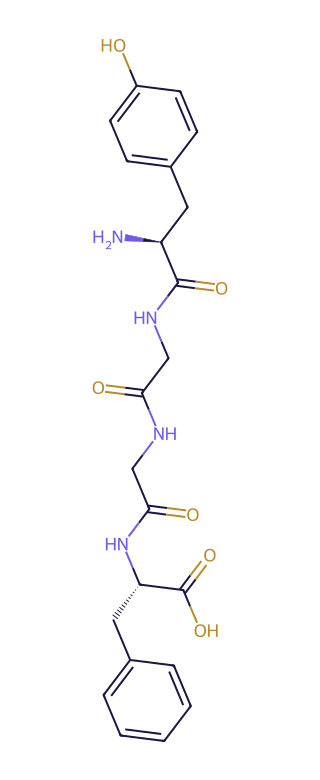
A peptide is a short chain of amino acids — the same building blocks that make up proteins — joined by peptide bonds. Chains of roughly 2 to 50 amino acids are called peptides; longer chains fold into proteins.
Your body already runs on peptides. Insulin controls blood sugar, oxytocin shapes bonding and labour, glutathione is a three-amino-acid antioxidant in every cell, and dozens of peptide hormones carry signals between organs. Because peptides are small and specific, they act like precise keys: each one fits a particular receptor and triggers a particular response. That specificity is exactly why they’ve become so interesting to medicine, skincare and supplement makers alike.
The map
Four categories — and they’re not the same thing
“Peptides” is used as one word for four very different things. They differ in what they do, how they’re regulated, and how safe and legal they are to buy. Knowing which category you’re looking at is the single most useful thing on this page.
Cosmetic peptides
Skincare ingredients like copper peptides (GHK-Cu) and Matrixyl that signal skin to make more collagen. Applied topically.
Legal · sold OTC 🥤Dietary peptides
Food-derived peptides sold as supplements — collagen peptides for skin, joints and hair, plus bioactive peptides from milk and soy.
Legal · supplement 💉Therapeutic peptides
Approved prescription medicines: insulin, the GLP-1 weight-loss and diabetes drugs (semaglutide, tirzepatide), oxytocin and many more.
Prescription only ⚗️Research peptides
Compounds like BPC-157 and TB-500 sold “for research use only.” Not approved for people; the legal and safety grey zone.
Unapproved · grey marketTap any category above for the full guide. Below is what unites them — and the safety and legal reality that separates them.
By what it does
Find a peptide by your goal
Most people don’t start with a peptide name — they start with a goal. Pick what you’re after and see which peptides are relevant, what the evidence says, and the legal, evidence-based options for each.
Inflammation & Tissue Repair
Healing, gut & injury recovery
Explore ⚡Mitochondrial Energy & Biogenesis
Cellular energy & biogenesis
Explore 🏃Recovery / Physical Progress
Muscle, training & bounce-back
Explore ⚖️Fat Loss
Appetite, weight & the GLP-1s
Explore 🧠Cognitive Enhancement & Focus
Clarity, memory & nootropics
Explore 🌿Stress & Anxiety
Calm, mood & resilience
Explore 😴Sleep
Falling & staying asleep
ExploreA note of honesty: several goal peptides are unapproved research compounds. Each page is clear about what’s proven vs experimental, and points to legal, evidence-based options.
Mechanism
How peptides actually work
Most peptides are messengers. Rather than forcing a chemical reaction, they bind to a receptor on a cell and tell it to do something — make collagen, release insulin, feel full, calm inflammation.
Specificity is the whole point
A peptide’s sequence is its identity. Change one amino acid and it can fit a different receptor, last longer in the blood, or stop working. That’s why drug makers spend years tuning a single sequence — and why two peptides that look almost identical can behave completely differently.
The delivery problem
Peptides are fragile: the gut digests most of them like food, which is why so many therapeutic and research peptides are injected rather than swallowed. Getting a peptide into the body intact — as a pill, a patch or a nasal spray — is one of the hardest and most active problems in the field. (A few, like oral semaglutide, have cracked it with special formulation.)
Why this matters for you
“It’s natural / your body makes it” does not mean a peptide is safe to buy and inject. Dose, purity, sterility and the exact sequence decide the outcome — and those are precisely what an unregulated product can’t guarantee.
The honest part
Safety & legality — by category
This is where the categories split hardest. The same word covers a face cream you can buy at a pharmacy and an unapproved injectable sold with a “not for human consumption” label.
✅ Cosmetic & dietary peptides
Topical cosmetic peptides and food-derived supplement peptides are legal and widely sold. They’re generally low-risk, though claims are often bigger than the evidence — look for real studies, not just marketing. Supplements aren’t pre-approved for effectiveness, so quality varies by brand.
💊 Therapeutic (prescription) peptides
Approved peptide drugs like the GLP-1s (semaglutide, tirzepatide) are effective but are prescription medicines for a reason — real side effects, contraindications and monitoring. The safe, legal route is a licensed clinician, not a website. “Research” or compounded copies of patented drugs sit in serious legal and quality trouble.
⚠️ Research / “grey-market” peptides
Peptides like BPC-157, TB-500 and melanotan are sold “for research use only” while everyone knows they’re injected by people. They are not approved for human use, evidence in humans is thin, and unregulated vials carry real risks:
- Purity & contamination — no guarantee of what’s actually in the vial, or that it’s sterile.
- Dosing — reconstitution and dosing errors are easy and can be dangerous.
- Legal exposure — selling them for human use is prosecuted; copies of patented drugs invite lawsuits.
We cover these so you understand them — not to help you buy them. If you’re considering any peptide for a health reason, talk to a licensed medical professional first.
Not medical advice. Chemdu is an educational resource. Nothing here is a recommendation to take, buy or sell any substance. Regulations vary by country and change over time — always check your local law and consult a qualified professional.
Common questions